
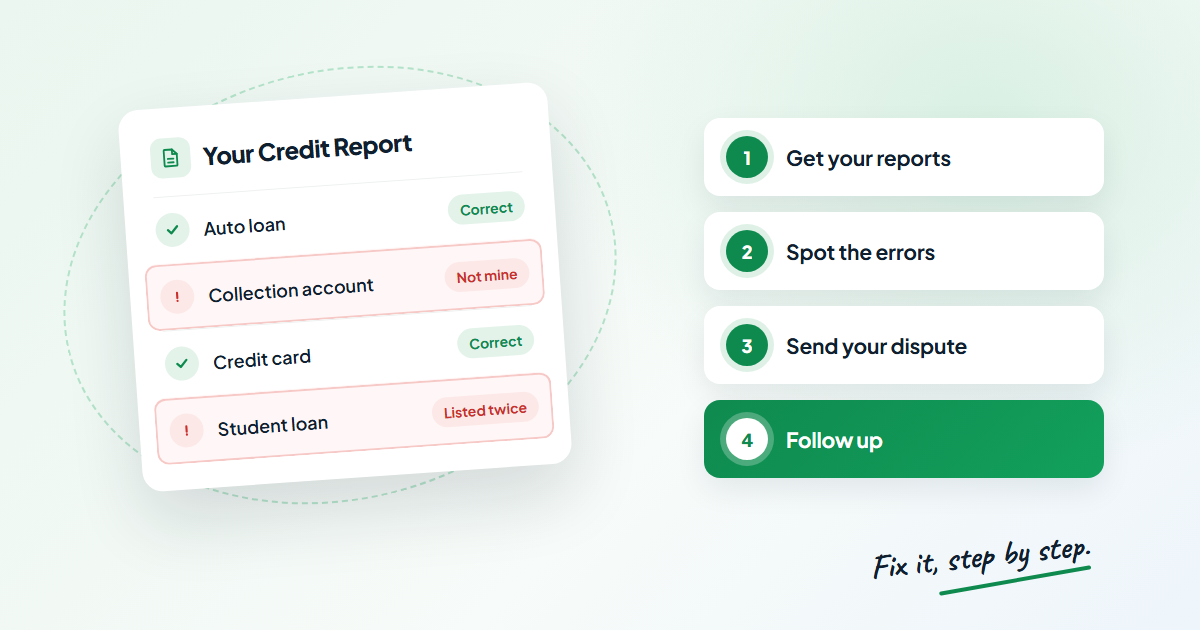
A Federal Trade Commission study found that about one in five people had an error on at least one of their credit reports, and many only find out when a loan is declined. The good news: you have a legal right to have mistakes investigated and corrected, and the process is the same for everyone. Here it is, step by step.
Get all three of your credit reports
Equifax, Experian and TransUnion each keep their own file on you, and they do not always match. An account can be correct on one report and wrong on another, so you need to see all three.
You are entitled to free copies from each bureau. The official place to get them is AnnualCreditReport.com. Checking your own report is a soft inquiry and does not affect your score.
Know what counts as an error
Read each report line by line and compare the three against each other. These are the mistakes that turn up most often:
| Type of error | What it looks like |
|---|---|
| Not your account | A loan, card or collection you never opened, often from a mixed file or identity theft. |
| Duplicate account | The same debt listed twice, for example under the original lender and again under a new servicer. |
| Wrong balance or limit | A paid-off loan still showing a balance, or a credit limit reported lower than it is. |
| Wrong payment status | A payment marked late that you made on time, or a closed account shown as open. |
| Outdated item | A negative item still listed after the reporting period has ended. Most stay for seven years; some bankruptcies stay for ten. |
| Wrong personal details | A misspelled name, an address you never lived at, or the wrong employer. |
Start with the errors that cost you the most. A collection that is not yours or a late payment you did not miss usually matters far more than a misspelled street name.
Gather your proof
A dispute is much stronger when you can show why the information is wrong. Before you write anything, collect copies of whatever supports your case:
- The report itself: the page showing the error, with the item circled or highlighted.
- Payment records: bank statements, cancelled checks or receipts that show the real balance or payment date.
- Letters from the lender: a payoff letter, a settlement agreement or an account-closure notice.
- Proof of identity: a copy of your ID and a recent utility bill, which the bureau needs to match the dispute to your file.
- A police or FTC identity-theft report if the account was opened by someone else.
Always send copies and keep the originals.
Send your dispute to the credit bureau
Dispute the item with every bureau that is reporting it wrong. You can do this online, by phone or by mail. Whichever you choose, your dispute should clearly say:
- Who you are: your full name, address and date of birth.
- What is wrong: the account name and number, exactly as it appears on the report.
- Why it is wrong: one or two plain sentences, with your documents attached.
- What you want: that the item be corrected or removed.
If you send it by mail, use certified mail with a return receipt so you have proof of the date the bureau received it.
The clock starts when the bureau receives your dispute. It generally has 30 days to investigate, and up to 45 days in some cases. It must then tell you the outcome in writing.
Tell the company that reported it
The bureau does not create the information on your report. It comes from the lender, card issuer or collection agency, known as the furnisher. Send the same dispute and the same copies to that company too.
A furnisher that finds its information was wrong has to notify every bureau it reported to, which can fix the error on all three reports at once.
Read the result and follow up
When the investigation is finished, the bureau sends you its decision. If the item was changed or removed, you also get a free copy of your updated report. Check that the correction really appears on it.
If the bureau says the item is correct
- Send new evidence: a second dispute with the same paperwork is likely to get the same answer, so add something the bureau has not seen.
- Add a statement: you can ask the bureau to include a brief statement of your side of the dispute in your file.
- Escalate: you can file a complaint with the Consumer Financial Protection Bureau.
One thing no dispute can do: remove information that is accurate. A late payment you really did miss stays on your report until its reporting period ends, no matter who sends the letter.
Let AI Credit Care do the checking
Reading three reports line by line is where most people give up. Our AI model compares your Equifax, Experian and TransUnion reports for you, flags items that look inaccurate, duplicated or outdated, and drafts each dispute for you to review. Nothing is sent until you approve it.
Common questions
View allDoes filing a dispute hurt my credit score?
No. Filing a dispute does not lower your score. Your score can change afterwards only if the dispute leads to information on your report being corrected or removed.
How long does a dispute take?
A credit bureau generally has 30 days to investigate after it receives your dispute, and up to 45 days in some cases. It must then send you the results in writing.
Do I have to pay to dispute an error?
No. Disputing inaccurate information with a credit bureau or with the company that reported it is free, and you can do it yourself.