
By Ankur Pandey | Updated November 24, 2026 | 9 min read
Facts checked against 15 U.S.C. 1681c, 1681i and 1681s-2, the CFPB’s guidance on credit report errors and negative information, the FTC’s guidance on disputing credit report errors, and the Experian, Equifax and TransUnion pages on how long information stays on a report, as of November 2026.
Quick answer Closing an account does not delete it. The bureaus say a closed account in good standing can stay on your report for up to 10 years, while negative information generally drops off after 7. That is normal. It is only an error if the account shows as open, shows the wrong balance or dates, or is reported as closed by the wrong party. Dispute those, and only those.
You closed a card, paid off a loan, or watched a lender shut an account, and months or years later it is still sitting on your report. Before you try to get rid of it, you need to know two things: whether it is supposed to be there, and whether the details are right. This page covers how long closed accounts stay, how to tell a normal listing from a mistake, how to dispute a real error, and why a clean closed account is often worth keeping.
In this guide
- Is it normal for a closed account to stay on my report?
- How long do closed accounts stay on a credit report?
- When a closed account is an error
- What if “closed by consumer” is wrong or missing?
- Can I remove a closed account?
- How to dispute a closed account that is wrong
- Why you might not want it removed
- What to keep
- Where AI Credit Care fits
- FAQ
Is it normal for a closed account to stay on my report?
Yes. A credit report lists current and past accounts, along with each account’s status, balance, payment history and open and close dates. The CFPB’s description of a credit report puts past accounts in the same list as current ones. A closed account is a finished chapter of your history, and the report is meant to show that history.
Experian says the same thing plainly on its help pages: closing an account does not remove it from your report. The account stays for a set period that depends on how it was paid.
A closed account that is still listed is not a sign of a problem. What matters is what the listing says.
How long do closed accounts stay on a credit report?
The answer depends on whether the account was in good standing when it closed.
| Account type | How long it can stay | Where this comes from |
|---|---|---|
| Closed, paid as agreed (good standing) | Up to 10 years | Experian, Equifax and TransUnion help pages |
| Closed with late payments or other negative history | Generally 7 years | Same pages, and the 7-year limit in federal law |
| Collection or charged-off account | 7 years, counted from 180 days after the missed payment that led to it | 15 U.S.C. 1681c(a)(4) and (c)(1) |
| Bankruptcy | Up to 10 years for some types, 7 for others | Bureau pages and 1681c(a)(1) |
A few details are worth knowing.
The 10 years for good accounts is a bureau practice, not a statute. The Fair Credit Reporting Act sets limits on how long negative items can be reported. It says nothing about closed accounts in good standing. The CFPB says positive information may be reported for longer than seven years without naming a maximum, and the bureaus’ own pages are where the 10-year figure comes from. Experian says good-standing closed accounts generally stay up to 10 years. Equifax and TransUnion give the same range of up to 10 years.
The bureaus do not describe the starting point identically. Experian counts from the date the account closed. Equifax’s page counts from the date the lender reported the account to Equifax. Two bureaus can therefore drop the same account at slightly different times, so check each report.
Negative history runs on a different clock. Experian says an account that was past due when it closed comes off seven years after the first missed payment in the series that led to the closure. A late payment on an account that you later brought current still ages out after seven years, even though the rest of that account can stay longer.
Paying does not restart the clock. Equifax says a late payment is counted seven years from the original missed payment even if you later pay the past-due balance, and collections run seven years from the first missed payment even if you pay them.
Example (invented). Sam closed a store card in January 2020 after paying it on time for six years. Going by Experian’s description, the account could stay until about January 2030. A different card Sam stopped paying in March 2021 would generally fall off around March 2028, seven years after the first missed payment, not seven years after it closed.
There are exceptions to the time limits. The 7- and 10-year limits do not apply to a report used for credit of $150,000 or more, life insurance of $150,000 or more, or a job paying $75,000 or more, according to the statute. Those reports can include older information.
When a closed account is an error
The listing being old is not an error. These are:
- The account shows as open when you or the lender closed it.
- The wrong party is shown as closing it. The report says the lender closed it when you did, or the reverse.
- The balance is wrong. A closed account that you paid off still shows an amount owed, or shows a larger one than your records.
- The dates are wrong. The open, close or last activity date does not match your statements.
- Payment history is wrong. Late marks you can show were on time, or late marks that appear after the account was closed and paid.
- The account is not yours, or it appears twice.
- It should have aged off already. Count from the dates above and your own records.
Compare each entry with your last statement, your closing or payoff letter, and your own notes. Pull your reports for free at AnnualCreditReport.com and check all three bureaus, because they are separate files and one can be right while another is wrong.
Only dispute information you believe is inaccurate, incomplete or unverifiable. If the account is yours, closed, accurate and old, there is nothing to correct.
What if “closed by consumer” is wrong or missing?
When you close an account yourself, federal law gives that fact special attention. Under 15 U.S.C. 1681s-2(a)(4), a company that regularly reports to the bureaus has to notify them when a consumer voluntarily closes a credit account. And under 1681c(e), once the bureau has been told, any report that includes that account must indicate that the consumer closed it.
That gives you a clear check. If you closed the account and your report is silent about it, or says the lender closed it, ask whether the lender ever reported the closure correctly.
Here is the order that tends to work:
- Find your proof. A confirmation email, a closing letter, a call log or a final statement showing a zero balance. Keep copies.
- Check all three reports. The lender may have reported correctly to one bureau and not another.
- Dispute the specific line. Say what the report shows, what is true, and what document backs you up.
- Dispute with the lender as well, which is covered below.
Experian notes that when a lender reports a closure, the account normally updates within one to two billing cycles. If it still shows open after a couple of months, that is the point to dispute. This is Experian’s description of its own process, so timing at the other bureaus may differ.
The bureau and CFPB pages we reviewed do not explain how a “closed by lender” label compares with “closed by consumer” when a lender reviews your report, so do not assume either way. The goal is simply an accurate label.
Can I remove a closed account?
You cannot remove an accurate one. Experian’s own help page says the same: there is no early removal for a closed account in good standing, and the bureau drops it automatically at the end of its period. For an accurate negative account, the report stays accurate until the 7-year limit runs out.
You can ask for removal in two situations:
- It is inaccurate, incomplete or unverifiable. That is the dispute route below.
- It is past its legal reporting period. An item that should have aged off can be challenged as outdated.
People also try goodwill letters, asking a lender to remove a late payment as a courtesy. Experian says lenders are not required to honor them. It is a request, not a right.
Be wary of anyone who promises to take accurate closed accounts off your report for a fee. The law provides no way to do that. See how to fix credit report errors for what genuine corrections look like.
How to dispute a closed account that is wrong
Dispute with the bureau and with the company that reported the account (the furnisher). You can do both.
- Pull all three reports and mark the entries that are wrong. The CFPB says to send a copy of the relevant part of your report with the disputed items circled or highlighted.
- Write what is wrong and why. Include your name, address and phone number, the account number, a clear explanation, and a request that the entry be corrected or removed. The CFPB’s dispute steps list this and say to send copies, never originals.
- Choose how to send it. You can dispute online, by mail or by phone, depending on the bureau. Certified mail with a return receipt gives you proof of delivery. Addresses and portals are in our credit bureau dispute addresses guide.
- Send a separate dispute to the furnisher. The CFPB says to send it to the address on your report or any address the company specifies for disputes. Under 1681s-2(a)(8), a direct dispute has to identify the specific information and explain why you dispute it. The CFPB says furnishers generally have 30 days to respond.
- Wait for results and read them. Under 15 U.S.C. 1681i, the bureau generally has 30 days to reinvestigate, extended by up to 15 days if you send relevant information during the first 30. It must send written results within five business days of finishing. If it finds an item inaccurate, incomplete or unverifiable, it must delete or modify it. The FTC adds that when a bureau changes an item, you also get a free copy of your report.
- Check your reports again to confirm the change took hold, at all three bureaus.
A bureau can decline a dispute it reasonably believes is frivolous or irrelevant, but it must tell you why within five business days. Saying exactly what is wrong makes that less likely. If a deleted item reappears, the bureau can reinsert it only if the furnisher certifies it is complete and accurate, and it must notify you in writing within five business days.
If the investigation ends and you still disagree, you can add a short consumer statement to your file. The statute allows the bureau to limit it to 100 words. For realistic timing, see how long a credit dispute takes.
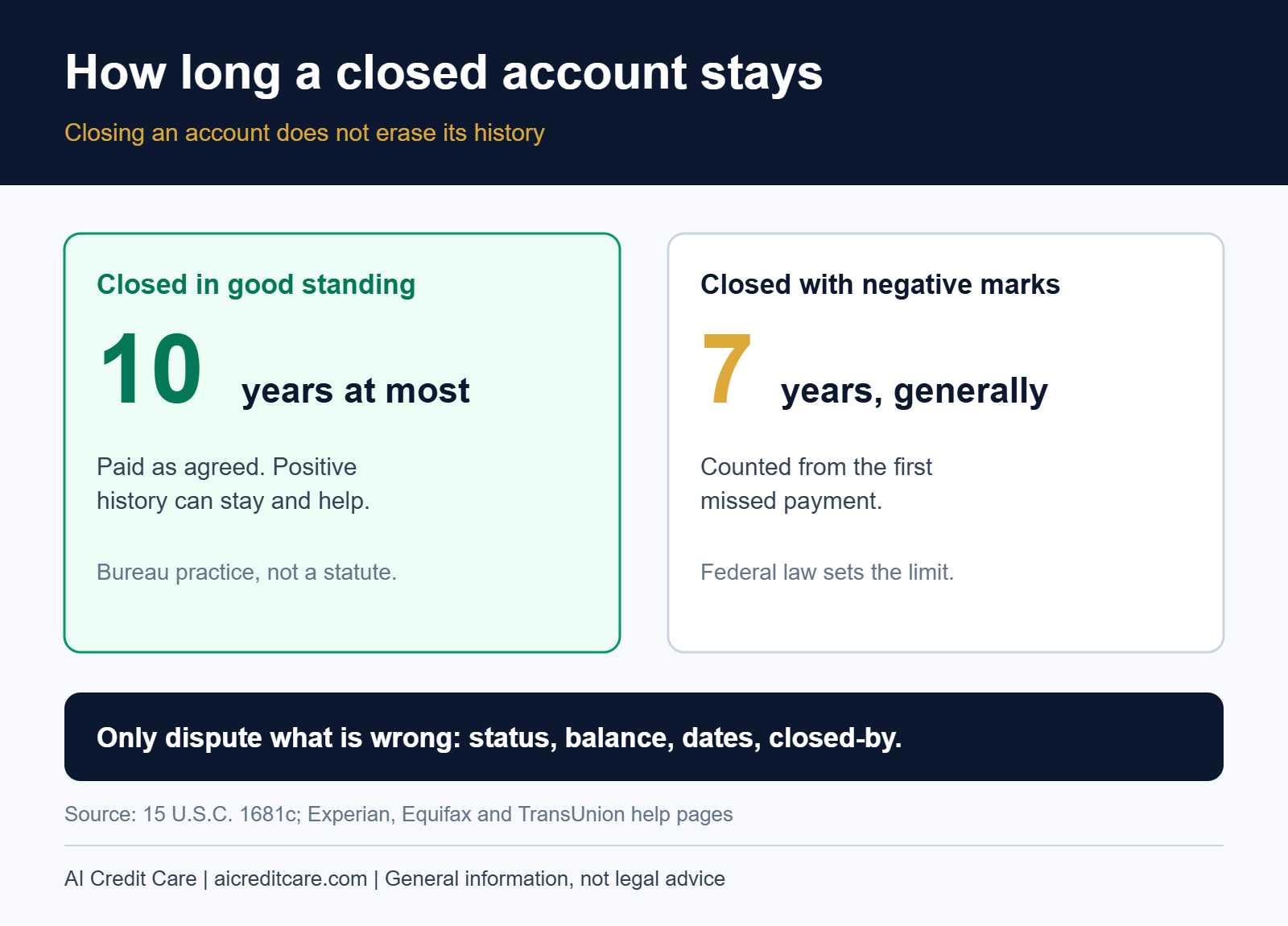
Closed accounts in good standing can stay up to 10 years, negative ones generally 7. Closing does not erase the history.
Why you might not want it removed
It is natural to want an old account gone. For a clean closed account, that is usually the wrong goal.
- It is positive history. Experian says positive closed accounts help build credit history, and that keeping them is generally beneficial.
- History length is a scoring factor. According to myFICO, length of credit history makes up about 15 percent of a FICO Score, and the importance of each category varies from person to person. The CFPB likewise notes that a long, well-managed history can help your score. Scoring models differ, and none of these pages says exactly how a closed account is treated, so this is a reason for caution and not a prediction.
- Closing a card, not keeping the listing, is what changes utilization. Experian says closing a card removes its credit limit, which can raise your utilization if you still carry balances elsewhere. That effect comes from the closure itself.
If an account is accurate and positive, there is little to gain by fighting it. Spend your effort on entries that are wrong.
What to keep
- Closing or payoff letters and confirmation emails
- Your last statement showing a zero balance
- Notes on calls with the lender: date, name, what was said
- Copies of your reports before and after you dispute
- Your dispute letters, certified mail receipts and return cards
- Bureau confirmation numbers and written results
- Any reply from the furnisher
Where AI Credit Care fits
AI Credit Care analyzes your Equifax, Experian and TransUnion reports, flags potential errors and explains why. It drafts dispute letters that you review, approve and send yourself. The analysis is free ($0), uses a soft check that does not affect your credit score, and needs no credit card. AI findings are estimates and can be wrong. You can always dispute for free on your own, using the steps above.
Get a free analysis of your reports, or see how it works.
FAQ
How long do closed accounts stay on a credit report?
Closed accounts paid as agreed can stay up to 10 years, according to Experian, Equifax and TransUnion. Negative accounts generally fall off after 7 years, counted from the first missed payment. Collections and charge-offs follow a 7-year rule that starts 180 days after the delinquency. Exact timing can differ by bureau, so check each report.
Why is my closed account still showing a balance?
Sometimes the lender never reported the final payment or the zero balance. Other times the balance is real, such as an unpaid amount at closure. Compare it with your last statement and payoff letter. If the report is wrong, dispute it with the bureau and the lender, attaching your proof.
Will a closed account hurt my credit score?
A closed account in good standing is positive history, and the pages we reviewed say keeping it is generally beneficial. A closed account with late payments or other negative marks can weigh on your score until it ages off. Closing a card can also raise utilization by removing its limit. Effects vary by scoring model.
What if my account was closed by the lender but I closed it?
Gather proof, such as a confirmation email or closing letter, and dispute the entry with each bureau showing it and with the lender. Federal law requires companies that regularly report to tell the bureaus when a consumer voluntarily closes an account. Say specifically what the report shows and what is true.
Can I get a closed account removed if I paid it off?
Paying does not remove it. An accurate closed account stays through its normal period, and a paid late payment is still counted from the original missed payment. You can dispute entries that are inaccurate, incomplete, unverifiable or past their reporting period. A goodwill letter is allowed, but lenders do not have to agree.
How do I dispute a closed account that is wrong?
Pull all three reports, circle the wrong entries, and explain what is wrong with copies of proof. Send it to each bureau showing the error, and send a separate dispute to the lender. Bureaus generally have 30 days to reinvestigate. Keep every confirmation, and check your reports afterward.
Sources
- 15 U.S.C. 1681c, requirements relating to information contained in consumer reports
- 15 U.S.C. 1681i, procedure in case of disputed accuracy
- 15 U.S.C. 1681s-2, responsibilities of furnishers
- CFPB: how long negative information remains on a report
- CFPB: how to dispute a credit report error
- CFPB: what is a credit report
- FTC: disputing errors on your credit reports
- Experian: how long closed accounts stay on your report, removing closed accounts in good standing and updating an account to show closed
- Equifax: how long information stays on your report
- TransUnion: how long closed accounts stay on your report
- myFICO: what’s in your credit score
About this guide. Written by Ankur Pandey for AI Credit Care. This is general information about consumer rights under federal law, not legal or financial advice. AI Credit Care is subject to the Credit Repair Organizations Act. You have the right to dispute inaccurate information on your credit report yourself, free of charge, directly with the credit bureaus. Results vary and are not guaranteed.