
By Ankur Pandey | Updated November 23, 2026 | 10 min read
Facts checked against the Fair Credit Reporting Act (15 U.S.C. 1681c, 1681e, 1681i and 1681s-2), the CFPB’s Regulation F text (12 CFR 1006.30, 1006.34 and 1006.38), CFPB and FTC consumer guidance, the CFPB’s 2023 market snapshot on collection tradelines, the FTC’s debt buying study, and Equifax and Experian help articles, as of November 2026.
Quick answer Often it is normal. When a lender sells or hands off a charged-off account, its entry can stay on your report with a $0 balance while the collector’s entry carries the balance. It is a reporting error when both entries show a balance, the delinquency dates conflict, or the details do not match your records. Compare balances, dates and account numbers before you dispute.
You pulled your reports and found what looks like one debt listed two times: once under the company you originally owed, once under a collection agency. Before you dispute anything, you need to know which of the two situations you are in, because one is routine and the other can be fixed. This page shows how to read each entry, the signs of a true duplicate, how to dispute it, and what changes when a debt has been sold more than once.
In this guide
- Is it normal to see the same debt listed twice?
- How to read the two entries side by side
- When two entries are legitimate
- When it is a reporting error
- What if the debt was sold more than once?
- Step by step: check and dispute a duplicate
- Should you pay the original creditor or the collector?
- What to keep
- Where AI Credit Care fits
- FAQ
Is it normal to see the same debt listed twice?
Sometimes, yes. Equifax says a charged-off debt may appear twice on credit reports, once from the original creditor and once from the collection agency or debt buyer. The CFPB’s 2023 market snapshot of collection tradelines makes the same point in a footnote: many creditors report to the bureaus, so information about the account from before it went to collections can show up alongside the collector’s entry.
What matters is how the two entries divide the debt between them. Experian describes the usual pattern: when a lender sells a charged-off debt to a collection company, the charged-off account’s balance changes to $0 and a separate collection account appears with a balance equal to the charged-off one. Two lines, one balance. That is the version you can usually expect.
It stops looking normal when both lines claim the money. A single debt that is counted as owed twice can overstate what you owe.
How to read the two entries side by side
Open each entry and copy the same handful of details into a simple grid. Experian’s guide to reading a report says collection accounts show the collector’s name, the original creditor, the original and current balances, and a status date, while an ordinary account shows a status such as open, closed or transferred.
| Detail | Original creditor entry | Collector entry |
|---|---|---|
| Company name | The lender or card issuer you dealt with | The agency or debt buyer |
| Original creditor named | Not needed | Should match the lender |
| Account number | Your original account number | Often a new number |
| Balance | Expected: $0 after a sale | The amount being collected |
| Status | Charged off, sold or transferred | Collection |
| Date of first delinquency | The date the account first went late | Should be the same date |
| Date opened | When you opened the account | Often the date the collector acquired it |
A later “date opened” on the collector’s entry is expected. Experian says the collection account’s open date reflects the purchase date, but the original delinquency date must stay the same as the original lender’s.The delinquency date is the one to watch. Federal law requires a furnisher that reports a delinquent account to supply the date the delinquency began (15 U.S.C. 1681s-2(a)(5)), and that date drives how long the item can stay on your report.
When two entries are legitimate
These patterns are consistent with how a sold or placed debt is normally reported:
- Original creditor shows charged off with a $0 balance; collector shows the balance. This is the sale pattern Experian describes above.
- The collector’s entry names the original creditor and the figures line up. The collector’s starting balance is close to the charge-off balance. Experian notes the collection balance may include possible interest charges on top of the original amount, so a higher figure is not automatically wrong, though you can ask how it was calculated.
- Same delinquency date on both. The two entries disagree on opening dates but agree on when the delinquency began.
Accurate entries that fit this pattern can stay for the full reporting period. Disputing an accurate entry does not change that. Experian says that when a valid debt is disputed only because the person disagrees with it going to collections, the account will likely be verified and stay on the report. Only dispute information you believe is inaccurate, incomplete or unverifiable.
When it is a reporting error
The Fair Credit Reporting Act requires a bureau to follow reasonable procedures to assure maximum possible accuracy of the information in your report, and it bars a company from furnishing information it knows or has reasonable cause to believe is inaccurate. Against that standard, these are the signs worth disputing:
- Both entries show a balance. The original creditor still reports an amount owed while a collector reports the same amount. Compared with the usual $0-after-sale pattern, this can make one debt look like two.
- The collector’s delinquency date is later than the original. A newer date can make an old debt look recent and change how long it stays. The seven-year period for a collection or charge-off starts 180 days after the delinquency that led to it (15 U.S.C. 1681c(c)(1)).
- Two collectors each report an open balance for the same original debt. Unless one of them has sold the account on, only one party should be collecting.
- The same collector lists the debt twice. If both entries share the original creditor and original account number, one debt is being counted twice. If the numbers differ, they may be two separate debts.
- You paid or settled it, but one entry still shows a balance. Payments can take time to post, so allow for that first.
- You never heard from the collector. A debt collector generally may not report to a bureau until it has spoken with you, or sent a notice and waited a reasonable period with no undeliverable response. Under the CFPB’s commentary, 14 days is a reasonable period. If a collector’s entry appeared and you never received a call or letter, say so in the dispute.
If the collector’s entry belongs to a debt that is not yours at all, that is a different dispute. See our guide to disputing a collection that is not yours.
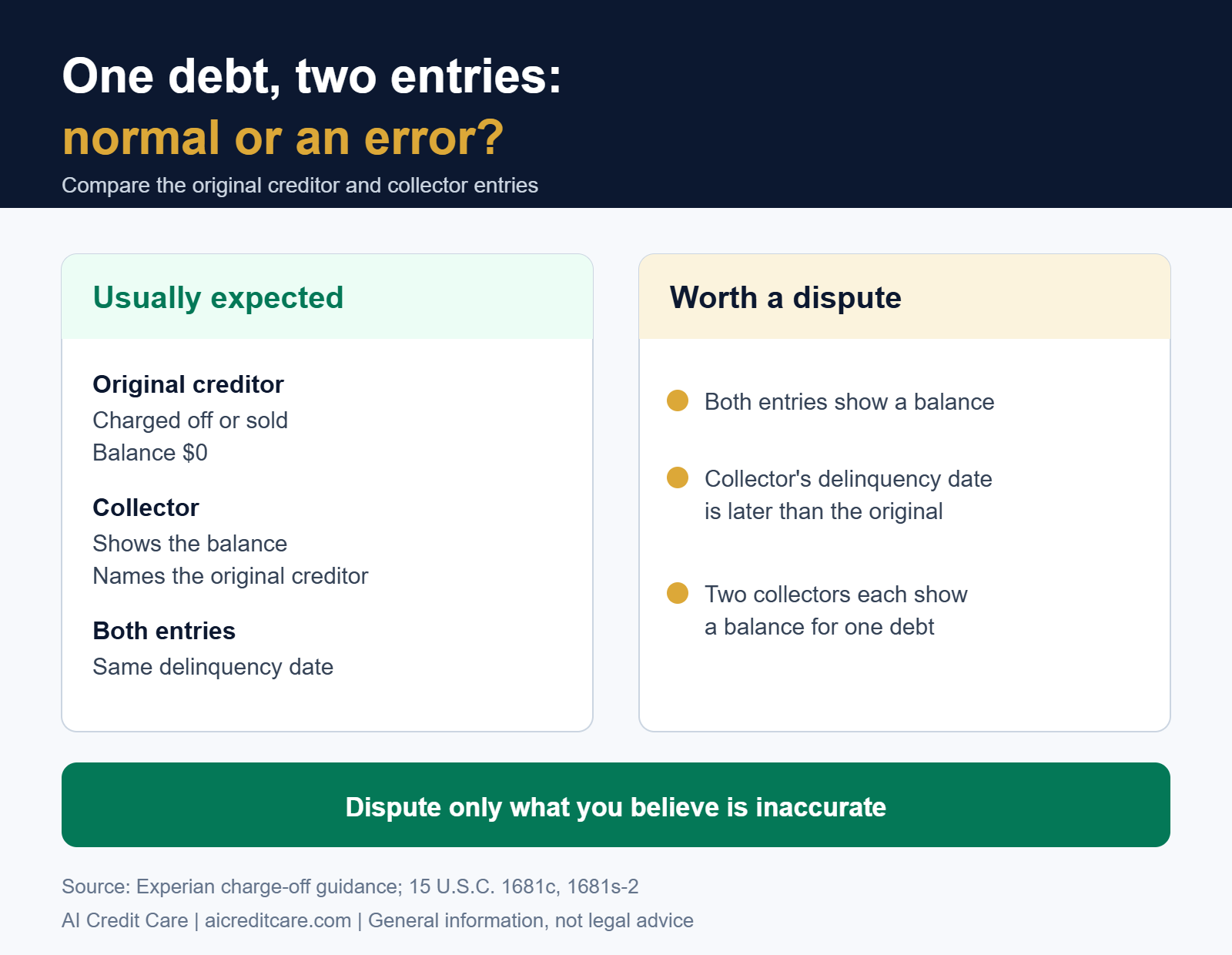
A $0 original-creditor entry plus one collector balance is the usual sale pattern. Two balances or conflicting dates are worth a dispute.
What if the debt was sold more than once?
Debts can change hands several times. The FTC’s study of the debt buying industry notes that many debts are purchased and resold several times over the course of years. Each sale can leave a trace on your report.
Experian says that when a collector resells a debt, the previous collection account is reported as closed and the new owner’s account opens on its purchase date. The original delinquency date carries over, so the newest account drops off at the same time as the others.
So a debt sold twice can legitimately produce three entries: the original creditor (sold, $0 balance), the first collector (closed), and the current collector (with the balance). Only the current one should show money owed.
To find out who owns the debt today, look at the validation notice. Under Regulation F the notice has to name the creditor to whom the debt is currently owed, the creditor as of the itemization date for consumer financial debts, and an account number. If a new collector contacts you after a sale, ask for validation information in writing and compare it with what your reports show. If one of these companies appears on your report, we have separate guides: Midland Credit Management, LVNV Funding and Credence Resource Management. AI Credit Care is not affiliated with any of them.
Step by step: check and dispute a duplicate
- Pull all three reports. The CFPB says AnnualCreditReport.com is the official source, with free weekly online access to Equifax, Experian and TransUnion reports. An entry can appear on one bureau and not another, so check each.
- List every entry tied to the debt. Use the grid above. Include the original creditor, each collector, account numbers, balances, status, and delinquency and open dates.
- Compare against your records. Your last statement, any charge-off notice and the validation notice help you tell a sale from a mistake.
- Decide what is wrong, specifically. For example: “The original creditor entry shows a $1,150 balance while a collection entry for the same account shows $1,150.” Vague disputes can be rejected. The CFPB says a bureau may reject a dispute it considers frivolous or irrelevant, such as one that does not say what is disputed, though it has to tell you within five business days and explain why.
- Dispute with each bureau that shows the problem. Say which entry you dispute, why, and what the correct information would be. The CFPB advises enclosing copies (not originals) of supporting documents, marking the disputed items on a copy of your report, and sending by certified mail with return receipt if you write. For addresses, see our credit bureau dispute addresses guide.
- Consider disputing with the company that reported it. Under 15 U.S.C. 1681s-2(a)(8), you can send a dispute straight to the furnisher at the address it designates for disputes, naming the specific item. The CFPB says furnishers generally must investigate and respond within 30 days.
- Track the clock. A bureau generally has 30 days to reinvestigate, up to 45 if you send relevant information during the first 30, and must send written results within five business days of finishing (15 U.S.C. 1681i). See how long a credit dispute takes for what to expect.
- Check your reports again. If the item is inaccurate, incomplete or unverifiable, the bureau must delete or modify it. If it is verified and you still disagree, you can add a short statement of dispute to your file (the bureau may limit it to 100 words), and you can file a complaint with the CFPB.
For the full procedure with sample wording, read how to dispute collections on your credit report. If you are unsure which reason to give, the guide on the best dispute reason for collections can help.
A caution on expectations: no dispute can guarantee a deletion. If the collector’s entry turns out to be accurate and the original creditor’s $0 entry is correct, both can remain.
Should you pay the original creditor or the collector?
Pay only after you know who owns the debt. Experian says that once a debt goes to collections, you deal with the collection agency, not the original creditor. The validation notice tells you who that is now. Equifax says that when a charged-off account is sold or transferred, you may be making payments to the collector or debt buyer instead of the lender.
If you decide to pay or settle, keep these points in mind:
- Do not pay two companies for one debt. If both claim a balance, ask each in writing who currently owns it before sending money.
- Get any agreement in writing first. The FTC advises getting a signed letter stating the payment settles the whole debt.
- Paying does not make the entry disappear. Equifax says a paid charge-off or collection stays on your report, although it may weigh less in some scoring models. Experian notes a settled account shows as settled rather than paid in full.
- Do not ignore a lawsuit. If you are served, respond by the date on the papers and speak with a consumer attorney or legal aid office.
Pay or dispute first is its own decision; see dispute or pay a collection.
What to keep
- Dated screenshots or PDFs of all three reports, plus your grid of entries
- The validation notice and the envelope or email it arrived in
- Your last statement from the original creditor, and any charge-off or sale letter
- Dispute letters as sent, certified mail receipts and confirmation numbers
- Every written response from a bureau, collector or original creditor
- Call notes (date, time, name, what was said) and written proof of any payment
Where AI Credit Care fits
AI Credit Care analyzes your Equifax, Experian and TransUnion reports, flags potential errors, such as entries that may describe the same debt, and explains why. It drafts dispute letters that you review, approve and send yourself. The analysis is free ($0), uses a soft check that does not affect your credit score, and needs no credit card. AI findings are estimates and can be wrong. You can always dispute for free on your own using the steps above.
Get a free analysis of your reports, or see how it works.
FAQ
Can the same debt be reported twice on a credit report?
Yes, in a limited way. Equifax says a charged-off debt may appear once from the original creditor and once from the collector. That is acceptable when the original shows $0 and only the collector shows a balance. If both show a balance, the debt may be overstated, and you can dispute the entry that looks wrong.
Why is my debt showing as both a charge-off and a collection?
The lender charged the account off as a loss, then sold it or placed it with a collector. The charge-off entry records what happened with the lender, and the collection entry records the new holder’s attempt to collect. Experian says the charge-off balance changes to $0 when the debt is sold, while the collection carries the balance.
Is a duplicate collection on my credit report illegal?
Not automatically. The law requires accuracy: bureaus must follow reasonable procedures for maximum possible accuracy, and furnishers may not report information they know or have reasonable cause to believe is inaccurate. Whether a specific duplicate breaks those rules depends on the facts. A consumer attorney can advise you on that.
Does paying the collection remove the original creditor’s charge-off?
No. Equifax says paying a charged-off account does not remove it. It shows as paid, and a paid collection stays too. Entries generally stay up to seven years from the first delinquency. Whether paid items count less depends on the scoring model.
How long does a debt stay on my report if it was sold several times?
Each sale does not restart the clock. Experian says the original delinquency date carries over to the new owner’s account, and the accounts come off together. Under federal law, the seven-year period begins 180 days after the delinquency that led to the collection or charge-off.
Sources
- 15 U.S.C. 1681s-2, furnisher duties
- 15 U.S.C. 1681c, time limits on reporting
- 15 U.S.C. 1681e, accuracy procedures
- 15 U.S.C. 1681i, bureau reinvestigation
- CFPB: 12 CFR 1006.30, reporting to consumer reporting agencies
- CFPB: 12 CFR 1006.34, validation information
- CFPB: 12 CFR 1006.38, disputes and requests
- CFPB: how to dispute a credit report error
- CFPB: free copy of your credit reports
- CFPB: market snapshot, third-party debt collection tradelines (February 2023)
- FTC: debt buying industry study and debt collection FAQs
- Equifax: what is a charge-off
- Experian: charge-offs, collection and original account, should I dispute a collection and reading your report
About this guide. Written by Ankur Pandey for AI Credit Care. This is general information about consumer rights under federal law, not legal or financial advice. AI Credit Care is subject to the Credit Repair Organizations Act. You have the right to dispute inaccurate information on your credit report yourself, free of charge, directly with the credit bureaus. Results vary and are not guaranteed.