
By Ankur Pandey | Updated November 6, 2026 | 10 min read
Facts checked against the CFPB and FTC dispute guidance, the Fair Credit Reporting Act (15 U.S.C. 1681i, 1681c, 1681c-2, 1681s-2), Regulation F (12 CFR 1006.30), the bureaus’ own dispute help pages and the bureaus’ April 2023 medical-debt announcement, as of November 2026.
Quick answer: There is no magic phrase. The best dispute reason for a collection is the specific, true reason you can back with a document: it is not your account, the balance is wrong, you paid it, the dates are wrong, it was discharged in bankruptcy, or it breaks a medical-collection policy. State that reason in one or two plain sentences, say exactly what should change, and attach copies of your proof.
You found a collection on your credit report and you’re staring at a dispute form that wants a reason. Pick the wrong one, or write something vague, and the bureau can treat your dispute as too thin to investigate. This page ranks the legitimate reasons by how easy they are to prove, shows what to attach for each, gives one sample sentence per reason, and explains the reasons that go nowhere.
In this guide
- Why “the best reason” means “the reason you can prove”
- The valid reasons to dispute a collection, ranked by proof
- Reason-to-proof table
- What to say when disputing a collection
- Do the reason options in online dispute forms matter?
- Reasons that don’t work
- What counts as a frivolous dispute?
- Where AI Credit Care fits
- FAQ
Why “the best reason” means “the reason you can prove”
When you dispute, the credit bureau has to run a reasonable reinvestigation, generally within 30 days. It can stretch to 45 days if you send relevant new information during that first 30 (15 U.S.C. 1681i(a)(1)). The bureau passes your dispute and your attachments to the company that reported the collection, and that company has to investigate too (15 U.S.C. 1681s-2(b)). If the item turns out to be inaccurate, incomplete or unverifiable, it must be corrected or deleted.
What triggers that outcome is a specific claim that can be checked. The CFPB’s guidance says to identify each error, explain clearly why it is wrong, say what you want done, and include copies (never originals) of supporting documents. The FTC says the same.
So the question isn’t “which wording sounds persuasive?” It’s “which statement about this collection is true, specific and documented?” Pick that one first. If you’re unsure which reason applies, our step-by-step collections dispute walkthrough shows how to read the entry line by line.
Only dispute information you believe is inaccurate, incomplete or unverifiable. If a collection is accurate, a dispute can’t remove it, and claiming otherwise can cost you time and credibility.
The valid reasons to dispute a collection, ranked by proof
The order below runs from the reasons that are usually easiest to document to the ones that need more digging. Your situation may differ, and a lower-ranked reason can still be the right one for you.
1. It isn’t your account, or it came from identity theft
What it means: You never opened the account, never owed the original debt, or someone used your identity. If you simply don’t recognize the collector’s name, check first: collectors often buy debts from a creditor you did know. Our guide to a collection that isn’t yours covers that check.
Evidence to attach: For identity theft, an identity theft report from IdentityTheft.gov plus proof of identity. For a mix-up (similar name, wrong address, wrong Social Security number), a copy of your ID and a document showing your actual address history.
Example: “I never opened this account or owed this debt. It resulted from identity theft; my identity theft report is attached. Please block it from my file.”
Caution: Identity theft has its own track. Under 15 U.S.C. 1681c-2, a bureau must block information that results from identity theft within four business days of receiving your proof of identity, a copy of the identity theft report, the specific items, and your statement that they don’t relate to your transactions. It can decline if the request was made in error, rests on a material misrepresentation, or you actually got goods, services or money from the transaction. Use this reason only if it is true.
2. Duplicate listing: the original creditor and the collector both show the balance
What it means: A debt was charged off by the original creditor and later sold or placed with a collector. Both entries show a balance owed, so one debt counts twice. The original creditor’s entry often shows a transfer or sale with no balance, so the debt appears once.
Evidence to attach: Your credit report pages with both entries marked, the collector’s letter naming the original creditor and account number, and any statement showing the sale or transfer.
Example: “Both the original creditor (account ending 1234) and the collector (account ending 5678) report a balance for the same debt. Please correct this so the debt is reported once.”
Caution: The two entries aren’t always the same debt. Match account numbers, dates and amounts before you claim a duplicate. If the original creditor correctly shows a zero balance with a “transferred” or “sold” note, there is nothing to dispute.
3. Wrong balance, interest or fees
What it means: The reported amount doesn’t match what you owe. Perhaps interest or fees were added that the original agreement doesn’t support, or payments you made weren’t credited.
Evidence to attach: The original statement or last bill, the collector’s validation notice, payment receipts or bank records.
Example: “The balance of $2,310 is incorrect. My last statement from the original creditor shows $1,640, and I’ve attached it with my payment records.”
Caution: “I think it should be lower” isn’t a reason. You need a number and a document. Whether particular fees are allowed can depend on the contract and state law, so be specific about what you can show.
4. Already paid or settled, but still showing a balance
What it means: You paid the collector in full or agreed a settlement and paid it, yet the entry shows an unpaid balance or “open” status.
Evidence to attach: A paid-in-full or settlement letter, a bank statement or cancelled check showing the payment, and the settlement agreement if there was one.
Example: “I paid this collection in full on 03/14/2025. The receipt is attached. The entry still shows a balance owed. Please update it to show a zero balance.”
Caution: Know what you’re asking for. Your dispute can correct a balance or status that is wrong; it can’t erase accurate history. A “settled for less than owed” note is accurate if you settled for less. Ask for the entry to match what happened.
5. Wrong dates: re-aging or past the seven-year limit
What it means: Federal law limits how long a collection can stay on your report. Collection accounts drop off seven years after they were placed for collection or charged off, and the seven years start counting 180 days after the delinquency that led to that action (15 U.S.C. 1681c(a)(4) and (c)(1)). A collector that shows a later delinquency date than the real one, which is called re-aging, can keep an item on your report too long. Furnishers must report the month and year the delinquency began (15 U.S.C. 1681s-2(a)(5)).
Evidence to attach: The earliest statement showing the account first went past due, the original creditor’s last payment record, and an older credit report that shows the earlier date (you can use AnnualCreditReport.com for your own reports).
Example: “The date of first delinquency is shown as 02/2021, but my original creditor’s statements show the account went past due in 06/2018. Please correct the date or delete the account if it is past the reporting limit.”
Caution: This is a strong reason only if your paperwork really shows the earlier date. Don’t guess the dates. Court judgments follow a different rule: the CFPB says they can be reported for seven years or until the statute of limitations runs out, whichever is longer.
6. Debt discharged in bankruptcy
What it means: The debt was included in a bankruptcy discharge, but the collection still shows an amount owed. A discharge releases you from personal liability for the debts it covers and bars creditors from taking collection action (U.S. Courts).
Evidence to attach: The discharge order, plus the schedule that lists the creditor.
Example: “This debt was discharged in my bankruptcy case (discharge order and schedule attached). Please update the entry to show it as included in bankruptcy with no balance owed.”
Caution: Not every debt is discharged. Some categories, such as certain taxes, support obligations and most government-funded student loans, are not. The bankruptcy itself can also stay on your report for up to 10 years under 1681c(a)(1); the dispute is about how this account is reported. A bankruptcy attorney or legal aid office can confirm what your discharge covered.
7. Medical collection that is paid, small or too new
What it means: Equifax, Experian and TransUnion jointly announced in April 2023 that paid medical collections no longer appear on reports (in effect since July 1, 2022), that medical collections with an initial balance under $500 were removed, and that unpaid medical collections wait one year before they can appear (TransUnion newsroom). The CFPB advised that if such an item still shows up, you can dispute it with the bureau (CFPB, May 2023).
Current status, as of November 2026: A federal court in Texas vacated the CFPB’s separate rule that would have removed most medical debt from reports on July 11, 2025 (CBS News). That rule’s loss didn’t cancel the bureaus’ own policies, and a September 2026 report says they remain in place (The Points Party). A current policy page from each bureau could not be opened when this guide was checked, so confirm on each bureau’s site before relying on this. These are voluntary policies that can change.
Evidence to attach: The medical bill or collector letter showing the original balance and the date of service, plus proof of payment if it’s paid.
Example: “This medical collection shows an initial balance of $340, below the bureaus’ $500 reporting threshold. My bill from the provider is attached. Please remove it.”
Caution: The CFPB noted this doesn’t cover credit card debt, even if you put a medical bill on the card. Some states have their own medical-debt reporting laws too, so check yours.
8. The collector reported it without required communication, or didn’t mark it disputed
What it means: Under Regulation F, 12 CFR 1006.30(a), a debt collector generally may not report a debt to a credit bureau until it has communicated with you about it. That means speaking with you in person or by phone, or sending a letter or electronic message and waiting a reasonable period without a bounce-back. Separately, once you dispute a debt with the company reporting it, it can’t keep reporting it without noting that you dispute it (1681s-2(a)(3)).
Evidence to attach: This one is hard to document. You’re asserting something didn’t happen. Your best evidence is your own records: that you received no call, letter or message before the entry appeared, and the date it first showed on your report.
Example: “I received no communication from this collector before it reported the debt. Please verify that it met the requirements of 12 CFR 1006.30(a) before reporting.”
Caution: Treat this as a supporting point, not your lead reason, unless you are certain. The regulation text doesn’t define how long a “reasonable period” is, and collectors often can show they mailed a notice. If the account is yours and the numbers are right, this alone may not change the outcome. For a dispute made with the collector itself, our post on financial recovery services collection disputes and the one on CPC debt show how those collectors handle disputes.
Reason-to-proof table
| Reason | What to attach (copies only) |
|---|---|
| Not your account / identity theft | Identity theft report, proof of identity and address |
| Duplicate listing | Report pages with both entries marked, collector’s letter naming the original creditor |
| Wrong balance or fees | Original statement, validation notice, payment records |
| Paid or settled, still shows a balance | Paid-in-full letter, bank record, settlement agreement |
| Wrong delinquency date or past seven years | Earliest past-due statement, older credit report |
| Discharged in bankruptcy | Discharge order and the schedule listing the creditor |
| Medical: paid, under $500, too new | Bill with date of service and original balance, proof of payment |
| No required communication / not marked disputed | Your own records of what you did and didn’t receive, plus the date the entry appeared |
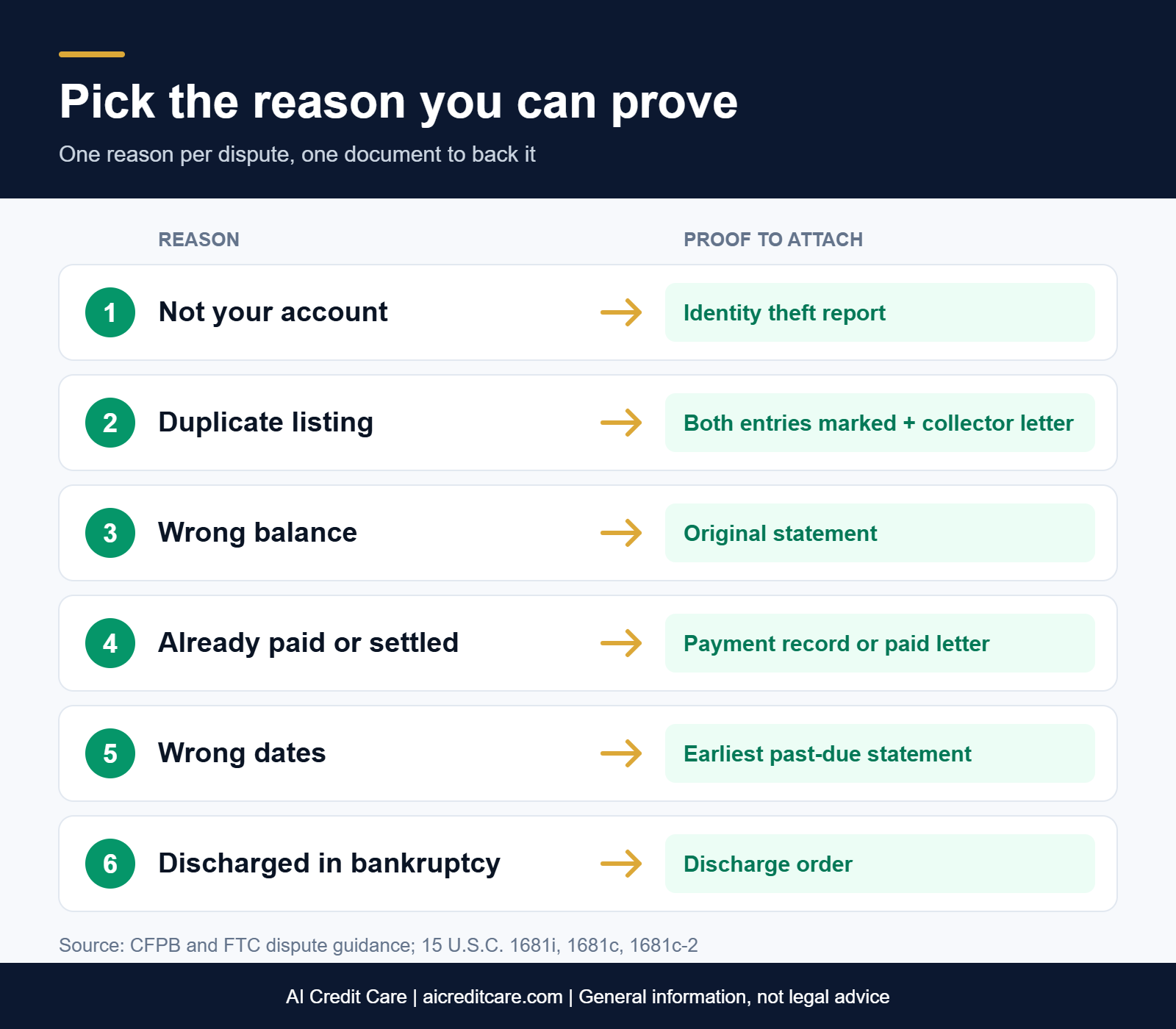
Pick the reason you can prove, then attach the one document that proves it.
What to say when disputing a collection
Short and factual works. Use this order:
- Identify the item. Bureau, collector name, account number as shown on the report.
- State what’s wrong. One sentence, one reason. If two things are wrong, list them separately.
- Say what should happen. “Delete,” “update the balance to $0,” “correct the date to 06/2018.”
- Point to the proof. “Attached: statement dated…, payment confirmation dated…”
- Keep copies. Keep what you sent and when you sent it, along with any confirmation number.
If you send a letter, the right address matters; see bureau dispute addresses. Our guide to fixing credit report errors covers the wider process, and how long a dispute takes explains what to expect while you wait.
If you can’t resolve it, the FTC notes that you can also dispute directly with the company that reported the item, and that if it keeps reporting the information it must tell the bureau, which then notes your dispute. You can also ask the bureau to add a short consumer statement to your file (the law allows the bureau to limit it to 100 words, per 1681i(b)). And if a dispute doesn’t fix a real error, you can file a CFPB complaint. Our post on what happens if you dispute a collection and lose covers those next steps.
What to keep: the credit report page with the item marked, copies of every document you sent, the date and method you sent it, any confirmation code, and the bureau’s written results.
Do the reason options in online dispute forms matter?
A little, but your explanation and attachments matter more. From the bureaus’ help pages as read in November 2026:
- Experian describes a “menu of dispute reasons” in its Dispute Center, and its help article tells you to explain your reason in your own words and be specific. You can upload documents online. Its page says disputes “should be resolved within 30 days.”
- Equifax says you file through myEquifax and get a confirmation code. Its page lists no formal reason codes, but it names documents to include depending on what you dispute, such as bank statements, lender letters, identity theft proof, or bankruptcy and court papers. Results are due within 30 days.
- TransUnion says the data provider has 30 days, in some cases up to 45, to verify the item. The pages reviewed list no reason options.
The forms may change, so what you see on screen is what counts. If a dropdown doesn’t contain your exact reason, pick the closest one and use the free-text box and upload to say precisely what’s wrong. A dropdown choice alone, with no explanation or proof, gives the bureau little to check.
Reasons that don’t work
- “It’s hurting my score.” Impact on your score isn’t an error. An accurate collection that is within the reporting period stays accurate.
- “I don’t like it” or “I can’t afford it.” Same problem: it doesn’t say what is inaccurate.
- A template that disputes everything. Generic letters that list every item with the same wording show no specific error, and bureaus can treat them as lacking enough information.
- Repeating the same dispute with nothing new. Experian’s own help page says that if you disagree with the result you can submit a new dispute with additional supporting information. A repeat with nothing added gives the investigator nothing new to check.
- Claiming “not mine” when it is yours. Don’t. It’s untrue, and a bureau can lift an identity-theft block that rests on a material misrepresentation. If you owe the debt but have a different issue (wrong balance, wrong date), use that accurate reason.
What counts as a frivolous dispute?
Under 1681i(a)(3), a bureau can stop a reinvestigation if it reasonably decides the dispute is frivolous or irrelevant. The statute specifically names a failure to give enough information as one way that happens. If the bureau does this, it must tell you within five business days, give its reasons, and identify what information it needs. Nothing is lost permanently: you can send a new dispute with the missing details.
For disputes you send directly to the company that reported the debt, the rule is slightly different. That company doesn’t have to reinvestigate a dispute that lacks enough information or that substantially repeats one it already handled (1681s-2(a)(8)(F)). The same statute says those direct-dispute duties don’t apply to disputes prepared for you by organizations covered by the Credit Repair Organizations Act, or sent on their forms (1681s-2(a)(8)(G)). Disputes you write and send yourself are not affected, and a dispute filed with the bureau triggers the bureau’s own duties under 1681i.
Where AI Credit Care fits
AI Credit Care analyzes your Equifax, Experian and TransUnion reports, flags potential errors and explains why each one was flagged. It can draft dispute letters for you to review, approve and send yourself. The analysis is free ($0), uses a soft check with no effect on your credit score, and doesn’t need a credit card. AI findings are estimates and can be wrong, so check every flagged item against your own records. Disputing is free to do yourself. Get a free analysis of your reports, or see how it works.
FAQ
What is the best thing to say when you dispute a collection?
State the one specific, true reason in a sentence or two, say what should change, and attach proof. For example: “The balance is wrong; my last statement shows $1,640, attached. Please correct it.” Specific and documented beats long and emotional. If the collection is accurate, don’t dispute it.
Can I dispute a collection just because it hurts my score?
No. A score drop isn’t an error. A dispute has to claim something is inaccurate, incomplete or unverifiable. A bureau can end an investigation of a frivolous or irrelevant dispute and must tell you why within five business days. If an item is accurate, a dispute can’t remove it.
How many times can I dispute the same collection?
The statute sections reviewed for this guide set no fixed limit, but each dispute needs a real basis. Experian’s help page says you can submit a new dispute with additional supporting information. A repeat that adds nothing can be treated as frivolous, and companies you dispute with directly don’t have to reinvestigate a dispute that substantially repeats an earlier one.
Do the reason options in online dispute forms matter?
Some. Experian describes a menu of reasons, while the Equifax and TransUnion pages reviewed list none. Whichever you see, your written explanation and uploaded proof do the real work. Choose the closest option, then say exactly what’s wrong in the free-text box.
Can I dispute a collection I already paid?
Yes, if the report is wrong about it, such as showing a balance after you paid in full. Attach the payment proof. A dispute can correct a wrong balance or status but can’t remove an entry that is accurate. Paid medical collections are covered by a bureau policy described above.
Sources
- CFPB: How do I dispute an error on my credit report?
- FTC: Disputing Errors on Your Credit Reports
- 15 U.S.C. 1681i, 1681c, 1681c-2, 1681s-2
- 12 CFR 1006.30 (Regulation F)
- Experian dispute help, Equifax dispute page, TransUnion dispute page
- Bureaus’ joint medical-collections announcement, April 2023 and CFPB, May 2023
- U.S. Courts: Discharge in Bankruptcy
About this guide. Written by Ankur Pandey for AI Credit Care. General information about consumer rights under federal law, not legal or financial advice. AI Credit Care is subject to the Credit Repair Organizations Act. You have the right to dispute inaccurate information on your credit report yourself, free of charge, directly with the credit bureaus. Results vary and are not guaranteed.