
By Ankur Pandey | Updated November 5, 2026 | 10 min read
Facts checked against Financial Recovery Services’ own dispute page (fin-rec.com), the CFPB’s debt collection and credit report guidance, the Fair Debt Collection Practices Act and Fair Credit Reporting Act texts, and Regulation F, all read in November 2026.
Quick answer: If a Financial Recovery Services (FRS) collection looks wrong, you have three separate routes: a written dispute to FRS, a dispute with each credit bureau for every inaccurate field, and a direct dispute with the company that reported the account. Each does a different job. Only inaccurate, incomplete or unverifiable information can be corrected or deleted. An accurate, verified collection can stay on your report for the legal reporting period.
You found “Financial Recovery Services” on a credit report, or a letter showed up with that name on it. Maybe the balance is off, maybe you don’t recognize the account, maybe you just want proof before you do anything else. This page walks through who to contact, what to ask for, what each side is legally required to do, and what to keep. Please only dispute information you believe is inaccurate, incomplete or unverifiable.
AI Credit Care is not affiliated with Financial Recovery Services.
In this guide
- Is Financial Recovery Services legit?
- Three routes: use the right one
- What to compare on your credit report first
- Route 1: dispute with the collector
- Route 2: dispute with the credit bureaus
- Route 3: dispute with the creditor or furnisher
- Example: the same balance listed twice
- Can you remove it? What the law allows
- What to keep
- Where AI Credit Care fits
- FAQ
Is Financial Recovery Services legit?
That is a fair first question, and the useful answer is about how to check, not a verdict. FRS’s own website describes the company as a professional debt collection agency, lists Financial Recovery Services, Inc. with an office in Mendota Heights, Minnesota, and names trade memberships (BBB Accredited Business, ACA International, RMAi). Those are the company’s own statements, and we haven’t independently verified them.
What matters more for you is whether the debt it is chasing is yours and whether the details are right. The CFPB advises confirming that a collector is legitimate and that you actually owe the debt before you share sensitive financial information, and not ignoring a real debt, because a collector may sue. Ask for written validation, compare it to your records, and call your state attorney general’s office if something about the contact seems off.
Three routes: use the right one
People often send one angry letter to the wrong place. A collection can be challenged in three places, and each has its own rules.
| 1. The collector | 2. The credit bureau | 3. The furnisher | |
|---|---|---|---|
| Who you contact | Financial Recovery Services | Equifax, Experian, TransUnion | The company reporting the account |
| What you ask for | A written dispute and proof of the debt | Correction or deletion of each wrong field | An investigation and correction of the data it reports |
| What the law requires | Pause collecting until verification is mailed, if you dispute in writing within the 30-day window | Reinvestigate within 30 days (up to 45 if you add relevant information) | Investigate and tell the bureaus if the data is wrong |
| Typical proof | Their notice, your ID, your records | Marked-up report copy, plus proof | Report excerpt, statements, proof |
Route 1 is about the debt and the collector’s duty to verify. Routes 2 and 3 are about what the credit report says. You can use more than one, and they often work together, which is why it helps to know which tool fits which problem.
What to compare on your credit report first
Before you write anything, pull your reports from AnnualCreditReport.com and read the FRS entry line by line. Then compare it with the validation notice and your own records. A short checklist:
- Collector name and account number. Does the collector name match the letter you received? Is the account number (often truncated) one you recognize?
- Original creditor. Is it a company you actually did business with? If the entry doesn’t name one, or names one you don’t recognize, that is a reason to ask for original creditor information.
- Balance. Does it match the amount on the notice, and does it make sense given the original debt plus any lawful interest and fees? Have payments you made been credited?
- Dates. Look at the date opened, the date of first delinquency (the start of the missed payment that led to collection) and the last activity date. The reporting clock depends on that delinquency date, so an error here matters.
- Status. Does it say open, paid, settled or disputed? If you already disputed, it should show as disputed.
- Duplicates. Does the same debt appear twice, once under the original creditor and once under the collector, both showing a balance owed?
Write down every mismatch with the exact wording from the report. A dispute that says “balance is wrong” gets less traction than one that says “report shows $X; the notice dated this day shows $Y”.
Route 1: dispute with the collector
Under the Fair Debt Collection Practices Act, a collector must send you a written validation notice within five days of first contacting you about a debt (unless the first contact already included that information). The notice has to show the amount, the creditor, and your right to dispute. Under Regulation F, it also has to give the collector’s dispute mailing address, the itemization date and amount, the interest, fees, payments and credits since then, the current amount, and the date your validation period ends. That period runs 30 days from when you receive the notice, and the collector may presume you received it at least five days after it was sent (not counting weekends and public holidays).
Why the date matters: if you dispute in writing before the period ends, the collector has to pause collection of the disputed debt until it mails you verification, a copy of a judgment, or the original creditor’s information, as 15 U.S.C. 1692g lays out. If the window has passed, you can still dispute and still ask for information, but that pause may not apply. The CFPB says it is still worth asking.
What FRS says about its own dispute process
As of November 4, 2026 (FRS’s Disputes and Validation page, which shows a May 12, 2026 publication date), FRS says:
- Disputes should be submitted in writing so that it can respond with account validation.
- You have the right to dispute within 30 days of receiving its initial communication.
- It typically sends validation information in writing within five days of its first communication.
- Disputes go to its Mendota Heights, Minnesota office or to an email address shown on the page. Certified mail is recommended.
- You should include as many details as possible and supporting documents, such as a police report if identity theft is involved.
That page lists phone numbers but does not say a phone call starts a formal dispute, and no dispute portal or fax number on it. Use the dispute address printed on your own validation notice first, since that is the address the rule requires the collector to give you. Contact details change, so check the page again before you mail anything.
How to send a dispute to the collector
- Find your deadline. Look for the validation period end date on the notice. Mark it on a calendar.
- Write a short letter. Include your name, address and the account or reference number. Say which part you dispute (the whole debt, the amount, or both) and why, in one or two sentences. Ask for verification of the debt, and, if you don’t recognize the creditor, the original creditor’s name and address. The CFPB publishes sample letters for each situation.
- Attach copies, never originals. Include any proof you have: payment records, a letter from the creditor, an identity theft report.
- Send it so you can prove it. Certified mail with return receipt, to the dispute address on the notice. Keep a copy of the letter and the receipt.
- Read the answer. If they send verification, compare it to your records and to the report. If it doesn’t match, move to routes 2 and 3.
Do not claim “this isn’t my debt” if it is. And if you are ever served with a lawsuit, respond by the deadline on the papers and speak with a consumer attorney or legal aid office. A dispute letter is not a response to a court. See our guides on how to dispute collections on a credit report and choosing the best dispute reason for a collection for wording.
One more rule worth knowing: a collector generally can’t report a debt to a credit bureau until it has communicated with you, either by speaking with you or by sending a letter or electronic message and waiting a reasonable period for undeliverable notices (12 CFR 1006.30(a)). If you never received any contact before the entry appeared, note that in your dispute.
Route 2: dispute with the credit bureaus
A collector’s validation and a credit report entry are separate things. The bureaus have their own duty to keep reports accurate, and you dispute with each bureau that shows the error. See our list of credit bureau dispute addresses.
The CFPB’s guidance says to explain in writing what is wrong and why, with copies of supporting documents. For a mailed letter, include:
- Your full name, address and phone number, plus your report confirmation number if you have one.
- Each error, with the account number.
- A clear explanation of why each is wrong (use your checklist).
- A request that the item be corrected or removed.
- A copy of that part of your report with the items highlighted, and copies of proof.
What happens next, under 15 U.S.C. 1681i:
- The bureau must reinvestigate for free within 30 days. If you send relevant new information during that time, it can take up to 15 more days.
- Within five business days of getting your dispute, it must pass your information to the furnisher.
- If the information is found inaccurate, incomplete or unverifiable, it must be promptly deleted or modified.
- It must send you the written results within five business days of finishing, with an updated report.
- It can end a dispute it reasonably considers frivolous, but it must tell you within five business days and say what it needs.
- If the dispute isn’t resolved in your favor, you can add a brief statement of dispute to your file, and later reports must note that the item is disputed.
Our post on how long a credit dispute takes covers the timeline in more depth.
Route 3: dispute with the creditor or furnisher
The furnisher is whoever reports the account: the collector, the original creditor, or both. Disputing with the furnisher directly is a separate right under the Fair Credit Reporting Act and Regulation V. Your notice has to identify the account, name the specific information you dispute, explain why, and include the supporting documents the furnisher reasonably needs. Send it to the address on your credit report, an address the furnisher clearly specifies for direct disputes, or, if none is specified, any business address.
If the furnisher gets your dispute, it must investigate, review what you sent, and report the results to you. If the information is inaccurate, it must notify each bureau it reported to and correct it. The CFPB says furnishers generally have 30 days to respond. A furnisher may also reject a dispute as frivolous, with notice within five business days. Also, a furnisher that reports something you’ve disputed has to note that it’s disputed (15 U.S.C. 1681s-2).
When a bureau passes your dispute along, the furnisher has its own duty to investigate and to modify, delete or block information it can’t verify. That is why a bureau dispute and a direct dispute can be paired.
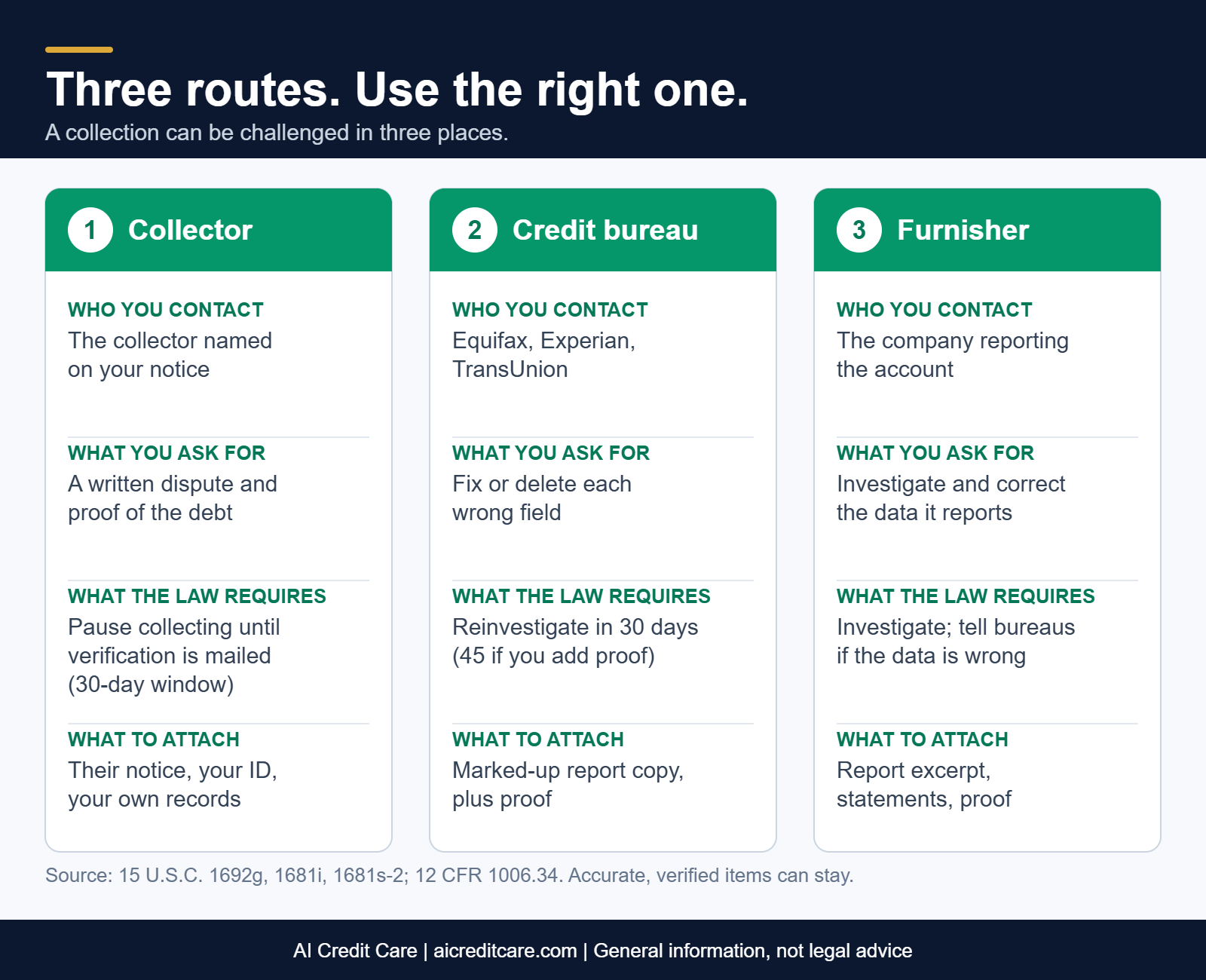
The three dispute routes side by side. Sources: 15 U.S.C. 1692g, 1681i, 1681s-2; 12 CFR 1006.34.
Example: the same balance listed twice
This is an invented scenario to show how the checklist works. The names and numbers are made up.
Example: Dana opens her report and sees two lines for one old account. “Example Bank” shows a balance of $1,240, status open. “Financial Recovery Services” shows $1,240 as a collection. Her validation notice from the collector lists the creditor as Example Bank and the amount as $1,240, with an itemization date of March 3.
What Dana can reasonably do:
- Compare the two entries. The same $1,240 appearing under both names looks like the debt being counted twice. A report alone can’t prove which line is correct, so she asks both to verify.
- Dispute with each bureau, listing both lines, stating that the same debt appears with a balance under two furnishers, and attaching the notice and her marked-up report.
- Send a direct dispute to Example Bank asking it to confirm whether it still reports a balance, since the account was placed with a collector.
- Send FRS a written request for verification within the validation window, and keep the receipt.
If the investigations confirm that both lines are accurate under how the accounts were transferred, they can stay. If one can’t be verified, it must be corrected or deleted. Dana doesn’t get to choose the outcome, and neither do you.
Can you remove it? What the law allows
You may see “remove Financial Recovery Services from credit report” promised online. Here is the plain version. Information that is inaccurate, incomplete or unverifiable must be deleted or corrected after a proper dispute. Information that is accurate and verified can stay for the reporting period. Under 15 U.S.C. 1681c, a collection account generally can’t appear more than seven years, counted from 180 days after the delinquency that led to the collection. A dispute does not restart that clock, and no one can lawfully promise a deletion.
If you lose a dispute because the item checked out, you still have options such as adding a consumer statement or going back with new evidence. We cover that in what happens if you dispute a collection and lose. Other collectors have their own guides, such as Credence Resource Management, LVNV Funding, Midland Credit Management and CPC debt. If you’re weighing whether to pay instead, see dispute or pay a collection.
What to keep
- Every letter, envelope and email from FRS, with dates received.
- Your validation notice and the date it arrived.
- Copies of each dispute you sent, plus certified mail receipts and tracking.
- Dated copies of your credit reports before and after each dispute.
- Payment records, creditor statements, and any identity theft report.
- A simple log of every call: date, time, name, what was said.
Where AI Credit Care fits
AI Credit Care analyzes your Equifax, Experian and TransUnion reports, flags potential errors and explains why. It drafts dispute letters that you review, approve and send yourself. The analysis is free ($0), is a soft check with no effect on your credit score, and needs no credit card. AI findings are estimates and can be wrong, and disputing is free to do on your own. Get a free analysis of your reports or see how it works.
FAQ
Can you dispute a collection agency on your credit report?
Yes. You can dispute any entry you believe is inaccurate, incomplete or unverifiable with the credit bureau, and you can dispute directly with the collector and the furnisher. The bureau must investigate, generally within 30 days. If the item is accurate and verified, it may stay.
Can a collection be deleted from a credit report?
Only if it is inaccurate, incomplete or unverifiable, or when the legal reporting period ends. Federal law lets a collection stay for up to seven years, counted from 180 days after the delinquency that led to it. No one can guarantee deletion of an accurate item.
Can a disputed debt be sent to collections?
The sources checked for this guide don’t say that disputing with a creditor stops it from placing the account with a collector, so don’t count on that. What the rules do say: a furnisher reporting a disputed item has to note the dispute, and a collector must pause collection if you dispute in writing within the validation window.
How do I dispute with Financial Recovery Services directly?
Send a written dispute to the dispute address on your validation notice, by certified mail, with copies of your proof. FRS’s own page, dated May 2026, says disputes should be in writing and within 30 days of its first communication. Ask for verification, and keep the receipt.
Do I need to pay it to make it go away?
No. Disputing and paying are separate. You don’t have to pay to dispute, and a valid dispute can proceed whether or not you pay. If the debt is yours and accurate, paying settles what you owe but may not change how the history is reported, so check what is shown on your report.
Sources
- Financial Recovery Services: Disputes and Validation and Contact
- CFPB: How do I dispute a debt with a debt collector?
- CFPB: How do I dispute an error on my credit report?
- 15 U.S.C. 1692g, 1681i, 1681s-2, 1681c
- 12 CFR 1006.30 and 1006.34 (Regulation F); 12 CFR 1022.43 (Regulation V)
- AnnualCreditReport.com
About this guide. Written by Ankur Pandey for AI Credit Care. General information about consumer rights under federal law, not legal or financial advice. AI Credit Care is subject to the Credit Repair Organizations Act. You have the right to dispute inaccurate information on your credit report yourself, free of charge, directly with the credit bureaus. Results vary and are not guaranteed. AI Credit Care is not affiliated with Financial Recovery Services.