
By Ankur Pandey | Updated November 4, 2026 | 9 min read
Facts checked against CPC’s own website pages, the CFPB’s Regulation F text (12 CFR 1006.30, 1006.34 and 1006.38), 15 U.S.C. 1692g, 15 U.S.C. 1681i and 1681s-2, and consumer guidance from the CFPB and FTC, as of November 2026.
Quick answer: To dispute a Central Portfolio Control (CPC) debt, send a written dispute to the dispute address on your validation notice before the end date printed on it, usually by certified mail with a return receipt. A timely written dispute requires the collector to pause collection until it sends verification. Then check your credit reports and dispute anything inaccurate with each bureau.
You got a letter or call from Central Portfolio Control, or you spotted that name on a credit report, and you want to respond correctly. This page covers the two separate tracks that matter: disputing with the collector inside the validation window, and disputing inaccurate reporting with the credit bureaus. It includes a sample letter, a checklist of what to keep, and what to do if the window has already closed. AI Credit Care is not affiliated with Central Portfolio Control.
In this guide
- Is Central Portfolio Control a debt collector?
- Two tracks: collector and credit bureaus
- What a validation notice must contain
- Step by step: dispute with CPC
- Example dispute letter
- What CPC must do after a timely dispute
- How to dispute on your credit report
- What if the 30 days have passed?
- What not to do
- What to keep
- Where AI Credit Care fits
- FAQ
Is Central Portfolio Control a debt collector?
Yes, by its own description. CPC’s website calls the company a licensed collection agency based in Minnetonka, Minnesota, and its pages carry the standard line that the communication is from a debt collector. Its disclosures page lists licenses or registrations in several jurisdictions, including California, Maryland, Minnesota and New York City.
That matters because a debt collector is covered by the Fair Debt Collection Practices Act (FDCPA) and by the CFPB’s Regulation F. Those rules give you the validation and dispute rights described below. Being a collector says nothing about whether the specific debt in your letter is correct. That is what the dispute process checks.
You can also look up a collector’s license yourself. Minnesota’s Department of Commerce keeps a license lookup directory that lists “Collection Agency” as a license type. Other states run their own regulators, so check the state where you live.
Two tracks: collector and credit bureaus
People often send one letter and assume it covers everything. It does not. There are two separate processes with separate deadlines.
| Track | Deadline | What it protects | Where to send |
|---|---|---|---|
| Validation dispute with the collector | In writing by the end date printed on your validation notice (30 days after you receive it) | Requires the collector to stop collecting the disputed debt until it sends verification | The dispute address on the notice |
| Dispute with a credit bureau | No fixed deadline for you; bureau generally has 30 days to reinvestigate, up to 45 in some cases | Asks for correction or deletion of inaccurate, incomplete or unverifiable items on your report | Equifax, Experian and TransUnion, each separately |
| Direct dispute with the furnisher (the company reporting the item) | No fixed deadline for you | Requires the furnisher to investigate the specific item you identify | The address the furnisher designates for disputes |
The first track is about the collection itself. The second and third are about what appears on your credit reports. For bureau addresses and portals, see the credit bureau dispute addresses guide.
What a validation notice must contain
A collector must give you validation information when it first contacts you or within five days afterward. Under Regulation F, the standard notice has to include, among other things:
- the collector’s name and the mailing address for disputes
- your name and address
- the name of the creditor the debt is currently owed to, and the creditor as of the itemization date for consumer financial debts
- an account number (it can be truncated)
- the itemization date, the balance on that date, and an itemization of interest, fees, payments and credits since then
- the current amount
- the end date of the validation period, with a statement of your rights if you dispute in writing by that date
The CFPB’s text of 12 CFR 1006.34 also describes a tear-off section where you can mark “This is not my debt,” “The amount is wrong,” or “Other.”
Compare the notice with your own records before you respond:
- Is your name spelled and addressed correctly?
- Do you recognize the original creditor and the account number?
- Does the balance on the itemization date match your last statement or records?
- Do the interest, fees, payments and credits make sense?
- Is the end date of the validation period printed on the notice?
The validation period runs 30 days from when you receive the notice. The collector is allowed to assume you received it at least five days after sending, not counting weekends and legal holidays. Use the date printed on the notice rather than counting for yourself.
Step by step: dispute with CPC
CPC’s own site does not publish a dedicated dispute procedure. Its contact page lists a main address (10249 Yellow Circle Drive, Suite 200, Minnetonka, MN 55343), phone lines and an email address, but says nothing specific about where written disputes should go. So use the dispute address printed on your notice, which Regulation F requires the notice to include. If your notice is missing or unclear, call CPC and ask for the dispute address in writing, and keep a note of the date and time.
- Check the date. Find the validation period end date on your notice. Put it on your calendar with a reminder a week earlier.
- Decide what you are disputing. Only dispute information you believe is inaccurate, incomplete or unverifiable. Be specific: if the amount differs from your records, say what the figure should be. Do not claim a debt is not yours if it is. Our guides on the best dispute reason for collections and on disputing a collection that is not yours go through the options.
- Write the letter. Keep it short and factual. Include your name, address, the account reference from the notice, the specific reason (for example, the amount differs from your records), and a request for verification. Attach copies, never originals, of anything that supports you.
- Send it by certified mail with a return receipt. Both the CFPB and the FTC suggest this because it gives you proof of delivery. Mail it early enough that it arrives before the end date.
- Keep a complete copy of the letter, the enclosures, the postal receipt and the return card when it comes back.
- Use the electronic route only if the notice offers one. Regulation F says an electronic notice must explain how to dispute electronically. If yours does, screenshot your submission and confirmation. A paper letter remains the cleanest record.
You can also ask for the original creditor’s name and address in the same letter if it differs from the current creditor. A written request inside the window also requires the collector to pause until it sends that information.
Example dispute letter
Example only. The name, address, account reference and amounts below are invented. Adapt the facts to your own situation and do not send details you cannot support.
Jordan Example
123 Sample Street
Anytown, ST 00000
[Date]Via certified mail, return receipt requested
[Collector name and the dispute address printed on your notice]
Re: Account reference ending 1234, notice dated [date]
I am writing to dispute this debt in writing within the validation period. The amount listed on your notice, $842.00, does not match my records, which show a balance of $410.00 on the itemization date. I am enclosing copies of the statement I am relying on.
Please stop collection of the disputed amount and send me verification of the debt, including how the amount was calculated. Please also send the name and address of the original creditor.
This dispute does not admit that I owe the debt.
Sincerely,
Jordan Example
No letter guarantees a particular outcome. The collector may verify the debt, adjust it or stop pursuing it, and you should be ready for any of those.
What CPC must do after a timely dispute
If you dispute in writing before the validation period ends, 15 U.S.C. 1692g(b) and 12 CFR 1006.38 say the collector must stop collecting the debt, or the disputed part of it, until it sends you verification or a copy of a judgment. Regulation F also allows a collector to treat a repeat dispute as duplicative if it is substantially the same as an earlier one and adds no new, material information.
Verification is not the same as proving every detail to your satisfaction. If it arrives and you still believe something is wrong, you can compare it with your records, raise the specific mismatch in a follow-up, dispute the item with the bureaus, or talk to a consumer attorney or legal aid office. If your dispute fails, what happens when you dispute a collection and lose explains the next options.
Not disputing within the window is not an admission that you owe the debt, and a court cannot treat your silence that way. But the collector can assume the debt is valid for collection purposes, so the written dispute is worth sending if you have a real basis.
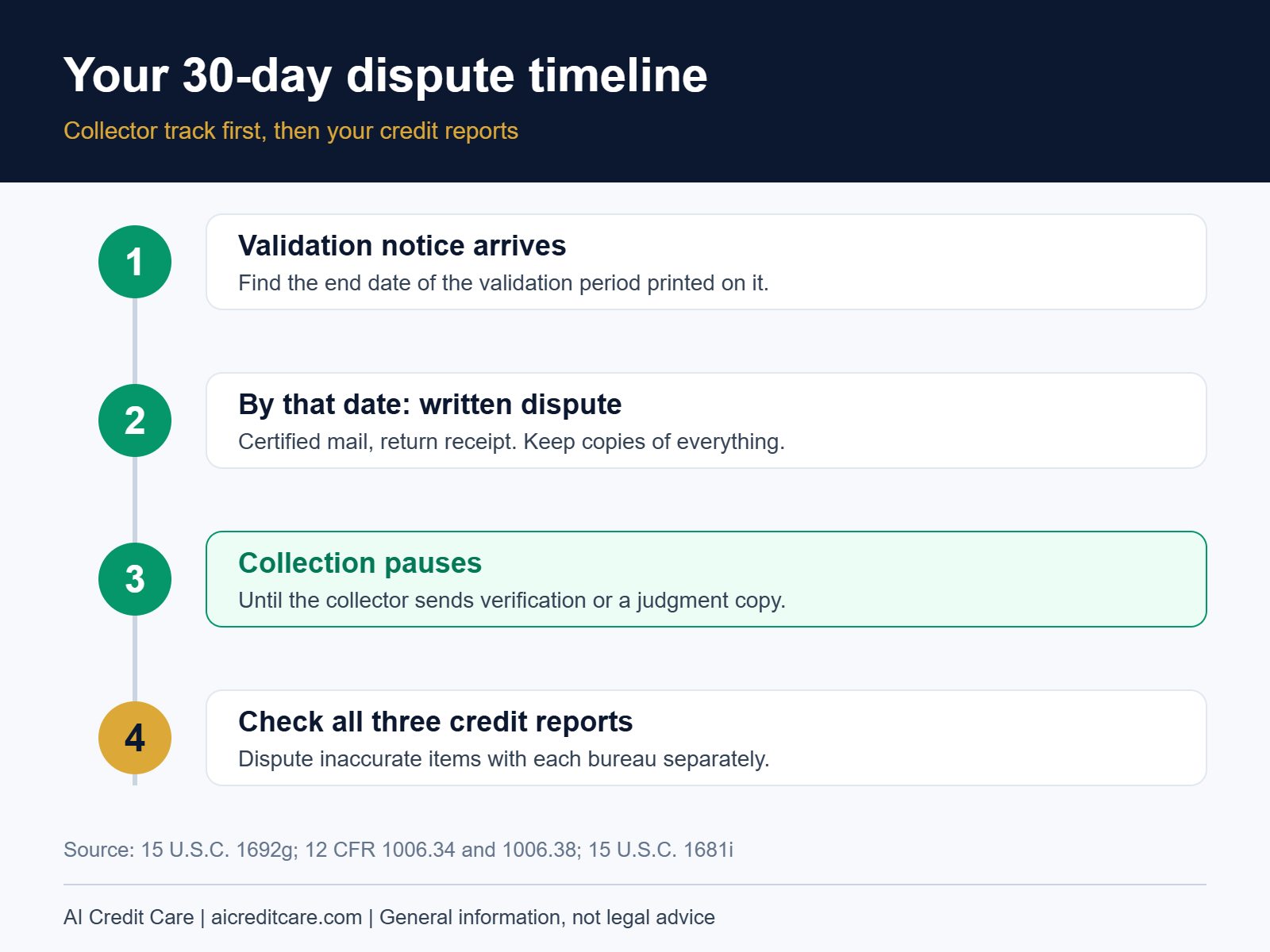
A written dispute sent by the end date on your notice pauses collection until verification. Check your reports afterwards.
How to dispute on your credit report
Your validation dispute and your credit report dispute are different processes. Sending a letter to the collector does not automatically change what the bureaus show.
First, get your reports. You can pull them free at AnnualCreditReport.com. Look for CPC or Central Portfolio Control by name, and check the original creditor too. Compare the balance, dates, account status and account number with your records.
Then dispute each inaccurate item with each bureau that shows it. The CFPB’s guidance on credit report errors says to explain in writing what is wrong and why, include copies of supporting documents, mark the disputed items on a copy of the report, and keep copies of everything. You can dispute online, by mail or by phone.
What the bureau must do under 15 U.S.C. 1681i:
- Reinvestigate at no cost within 30 days, or up to 45 if you send relevant information during the 30 days.
- Notify the company that reported the item within five business days and pass along what you sent.
- Delete or correct an item that is inaccurate, incomplete or unverifiable.
- Send you the results in writing within five business days after finishing.
- Reject a dispute only if it reasonably concludes it is frivolous or irrelevant, and tell you why within five business days.
If the dispute does not resolve in your favor, you may add a short consumer statement to your file explaining your side. For a step by step walk-through of this process, see how to dispute collections on your credit report.
You can also dispute directly with the company that reported the item. Under 15 U.S.C. 1681s-2(a)(8), you send the notice to the address the furnisher designates, identify the specific item and explain why you dispute it. The CFPB says furnishers generally must investigate and respond within 30 days.
One limit applies. An item that is accurate, complete and verifiable can stay on your report. Disputing it will not change that. A collector can generally report to the bureaus only after it has communicated with you about the debt, as 12 CFR 1006.30(a) explains, so if a CPC account appears on your report and you never received any letter or call about it, say so in your dispute.
CPC’s website says that in some cases accounts may be reported, and that if a reported account is paid in full or settled for less than the balance, it requests deletion of its tradeline about 30 days after the final payment posts. That is CPC’s description of its own practice, not a rule that applies to every account, and you should get any such promise in writing before paying. If you are weighing whether to pay or dispute, the same caution applies. Other collectors follow different processes; for examples, see our guides on Credence Resource Management, LVNV Funding and Midland Credit Management.
What if the 30 days have passed?
You can still dispute. The CFPB says you can dispute a debt at any time, but the automatic stop on collection applies to written disputes sent within the 30-day window. Regulation F’s verification rule is written for communications made during the validation period.
After the window, your practical options are:
- Send a written dispute and verification request anyway, and keep proof of delivery. The collector may or may not pause.
- Dispute inaccurate credit report items with the bureaus and the furnisher. Those rights do not depend on the validation window.
- Check your state’s rules. CPC’s disclosures page lists extra consumer rights for residents of several states, including California, Colorado, Massachusetts and Washington, and other states have their own laws.
- File a complaint with the CFPB if you believe a rule was broken.
- Speak with a consumer attorney or legal aid office, especially if you were served with court papers.
What not to do
- Do not ignore a lawsuit. If you are served with court papers, respond by the date on them and talk to a consumer attorney or legal aid office. The FTC warns that ignoring a suit can cost you the chance to contest the outcome.
- Do not pay before you have verified the debt, unless you have decided the debt is correct and you understand what the payment does. For older debts, the FTC notes that in some states a partial payment can revive a debt that is past the time limit for suing.
- Do not hand over bank account access or card details until you have checked the validation information. The FTC advises against sharing personal or financial information before you have it.
- Do not claim “not mine” when it is. Only dispute information you believe is inaccurate, incomplete or unverifiable.
- Do not send original documents. Send copies and keep the originals.
- Do not rely on phone calls alone. A call is fine for questions, but the written dispute is what triggers the legal protections.
What to keep
- The validation notice and envelope, with the date you received it
- Your dispute letter, as sent, and any enclosures
- The certified mail receipt and the signed return receipt
- Notes on every call: date, time, name, what was said
- Every response from CPC, including any verification
- Copies of your credit reports before and after you dispute
- Bureau dispute confirmation numbers and results letters
- Court papers, if any, with the date you received them
Where AI Credit Care fits
AI Credit Care analyzes your Equifax, Experian and TransUnion reports, flags potential errors and explains why. It drafts dispute letters that you review, approve and send yourself. The analysis is free ($0), uses a soft check that does not affect your credit score, and needs no credit card. AI findings are estimates and can be wrong. You can always dispute for free on your own, using the steps above.
Get a free analysis of your reports, or see how it works.
FAQ
Is Central Portfolio Control a debt collector?
CPC describes itself as a licensed collection agency based in Minnetonka, Minnesota, and its communications carry the standard debt collector statement. That means the validation and dispute rights in federal law apply. You can confirm licensing with your state regulator. AI Credit Care is not affiliated with CPC.
How do I dispute a debt with Central Portfolio Control?
Send a written dispute to the dispute address on your validation notice before the end date printed on it, preferably by certified mail with a return receipt. State what you dispute and why, ask for verification, enclose copies of support, and keep everything. CPC’s public pages do not give a separate dispute address, so rely on your notice.
What happens after I dispute a CPC debt?
If your written dispute is timely, federal law requires the collector to stop collecting the disputed amount until it sends you verification or a copy of a judgment. After that it may resume collection. It might also treat a repeat dispute with nothing new as duplicative. The outcome varies by debt and is not guaranteed.
Can I dispute a CPC collection with the credit bureaus too?
Yes. Disputing with the collector and disputing with Equifax, Experian and TransUnion are separate processes. If a CPC account on your report looks inaccurate, incomplete or unverifiable, dispute it with each bureau showing it. They generally have 30 days to reinvestigate, up to 45 in some cases. Accurate, verifiable items can remain.
How long do I have to dispute?
To trigger the collector’s duty to pause, send your written dispute by the validation period end date on your notice, which falls 30 days after you receive it. You can still dispute inaccurate credit report items with the bureaus and the furnisher after that, but the automatic pause on collection may not apply.
Do I need to dispute CPC online?
CPC’s public pages do not describe an online dispute portal. Regulation F says an electronic notice should explain how to dispute electronically, so check yours. If it offers no electronic route, use a certified letter. For bureau disputes, each bureau has an online option.
Sources
- CPC (cpcrecovery.com): FAQ, Contact and Disclosures
- CFPB: 12 CFR 1006.34, validation information
- CFPB: 12 CFR 1006.38, disputes and requests
- CFPB: 12 CFR 1006.30, reporting to consumer reporting agencies
- 15 U.S.C. 1692g, validation of debts
- 15 U.S.C. 1681i, bureau reinvestigation
- 15 U.S.C. 1681s-2, furnisher duties
- CFPB: how to dispute a debt and after you dispute
- CFPB: disputing a credit report error
- FTC: debt collection FAQs
- Minnesota Commerce: license lookup
About this guide. Written by Ankur Pandey for AI Credit Care. This is general information about consumer rights under federal law, not legal or financial advice. AI Credit Care is subject to the Credit Repair Organizations Act. You have the right to dispute inaccurate information on your credit report yourself, free of charge, directly with the credit bureaus. Results vary and are not guaranteed.